


 After hearing the phrases "...was completely destroyed" and "...all the people were killed" repeatedly over a four hour period, you'd think that they would start to lose their meaning and you would become numb to them. But of course you don't... you only wish you did.
Ultimately deciding it would be much easier to take an organized tour than to attempt to navigate Warsaw ourselves with no Polish language skills, Perry and I hooked up with a small tour company recommended by the hotel. Our guide was amazing and, since there were only six of us in the group (all of whom were nice and well-behaved), I didn't want to shoot myself like I usually do in organized tours.
The long and tragic history of Poland would be enough to make you fall into despair if not for the astounding resilience of the Polish people themselves. At every turn, and under unimaginable conditions, the Poles have chosen to be inspired by their past instead of be beaten down by it. The country has been invaded and divided multiples times (and was even erased off the map completely at one point) but still endures. Who could blame anybody for taking inspiration from that?
The tour started in Park Łazienkowski which features one of many statues of Józef Piłsudski, who is largely responsible for Poland regaining independence after over 120 years of being divided up amongst neighboring countries...
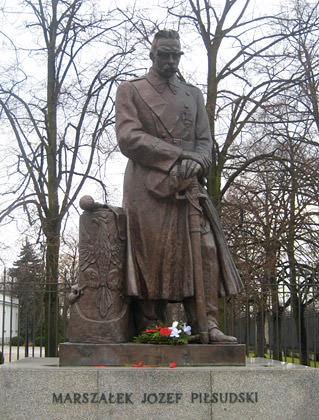
The statue is a pretty incredible work of art, accurately portraying Piłsudski as the contemplative leader he was. Despite some later controversy he is still very much in the heart and minds of Poland, and rightfully so.
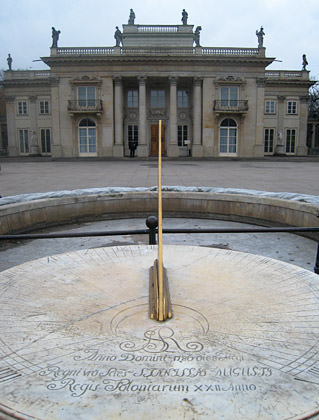
Continuing through the park, we came across "The Palace on the Water" which started out as a Turkish bath house but was ultimately expanded and remodeled by Poland's last king, Stanislas August Poniatowski. Photos weren't allowed inside, which is unfortunate, because the craftsmanship and art collection is astounding (which belies its rather plain exterior). Much of the palace was destroyed by the Nazis in retaliation for the Warsaw Uprising in 1944. But unlike most historic buildings that were eradicated in the systematic destruction of Warsaw, the palace managed to survive and has been restored as best they could. Out front I found a sundial which made for a nifty vantage point...
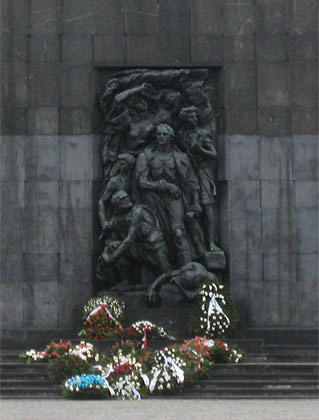
After a very cold walk through the park, we headed to the Jewish Ghetto which was established by the Nazis during World War II. It was here that Jewish natives were confined in unimaginably harsh conditions. Those who did not die from disease and starvation were relocated to concentration camps, extermination camps, or murdered outright on the streets. Over a three year period, the population dropped from 450,000 to 70,000 people, and it became clearly evident to those interned in the ghetto that the only thing awaiting them was annihilation. This led to the Warsaw Ghetto Uprising, which was the first civil uprising of the war. There was no hope... NO hope... of victory, and the fighters knew that any resistance would be futile, but they wanted to die for a reason instead of being mindlessly exterminated. Ultimately this led to the complete destruction of the ghetto, as 56,000 Jews would lose their lives after three months of struggle. This is remembered by Warsaw in the "Monument to the Ghetto Heroes" at the site...
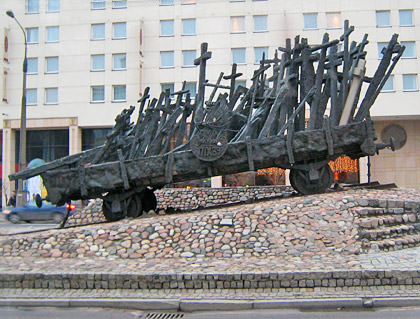
From there we headed toward "Old Town" Warsaw, stopping next to the "Monument for the Fallen and Murdered in the East." This sculpture has dozens of crosses stuck to a rail car, symbolizing all those who were transported to the east and murdered in Russian camps under Stalin. Poland just can't catch a break, at first thinking that the Russians would help them against German invasion, but was instead ultimately persecuted by them as well...
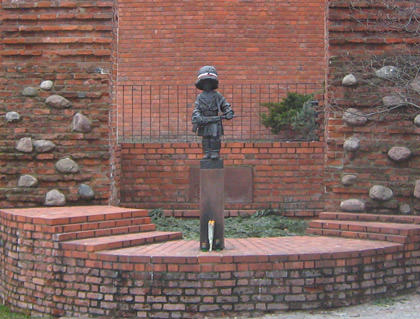
There's another heartbreaking monument outside Old Town's medieval walls that commemorates the children who fought during the Warsaw Uprising...
Like much of Warsaw, Old Town was systematically destroyed by the Germans as a punishment for the Warsaw Uprising. After World War II had ended, the people of Warsaw decided to rebuild Old Town as close to the original as they could using old paintings and recovered artifacts as reference. The result is an exquisite reconstruction that just seems to get more beautiful as the day wore on...
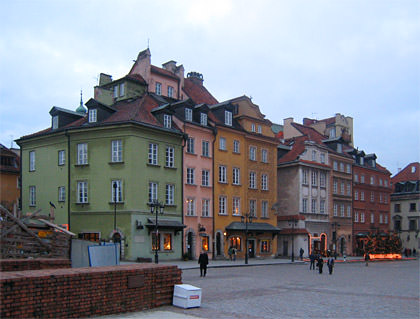
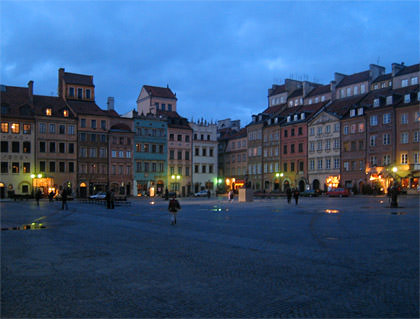
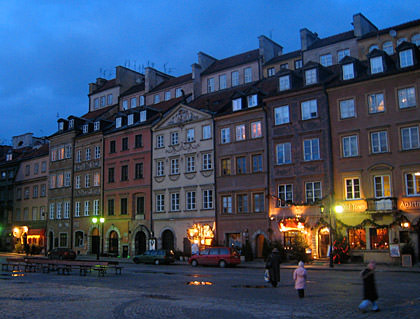
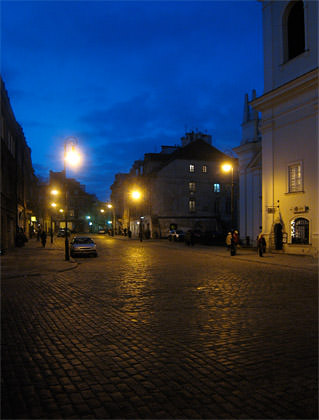
And thus ended our short tour of the city.
Tomorrow I absolutely want to return to Old Town and the many shops that line the main square there. Three days in Warsaw isn't even going to scratch the surface.

I love comments! However, all comments are moderated, and won't appear until approved. Are you an abusive troll with nothing to contribute? Don't bother. Selling something? Don't bother. Spam linking? Don't bother.
PLEASE NOTE: My comment-spam protection requires JavaScript... if you have it turned off or are using a mobile device without JavaScript, commenting won't work. Sorry.
 Atom Entries Feed Comments Feed








Wow, Dave, sounds like an awesome city. Glad you have been able to visit! Your tour reminds me of my day spent at the Dachau Camp in Munich. I came out of there sad and shaken.
Have fun in Old Town!
That monument to the children is heartbreaking. I never really knew all that much about Poland, so thanks very much for this post Dave! I’ve an urge to learn a bit more.
“At every turn, and under unimaginable conditions, the Poles have chosen to be inspired by their past instead of be beaten down by it. The country has been invaded and divided multiples times (and was even erased off the map completely at one point) but still endures.”
Thank you Dave.
At one point I had a relative in Patton’s 3rd Army (Uncle John) at the same time there was a relative fighting in that Uprising.
I guess we had Hitler surrounded. Fucker didn’t stand a chance…
It’s lame, but ever since seeing The Pianist, I have wanted to visit Warsaw because of it’s history, but I am not sure if I would handle the intensity of it very well.
I am so happy that you’re enjoying that beautiful city….and even more happy that you posted several excellent shots of the old town square where my group sang in 1986. While it was closed! Excellent memories. Thanks for reminding me. As for the gay travel thing…..Warsaw is going to be the very first former Eastern block city to host EuroGay (or whatever it’s appropriate name is) in 2010. Crazy considering the country’s conservative nature. We miss you!
Granddaughter… It is very hard not to get choked-up hearing about the atrocities these people have had to endure. After our guide had explained that entire streets of the Jewish Ghetto were blocked off and everybody within the blockade would be taken off to extermination camps to be murdered, I felt physically ill. Fortunately our young guide, who was very wise, said “it is depressing, but it is our history, so there is nothing we can do but learn from it and do better.” After knowing how he dealt with it, I was able to find a way to do so also.
Mooselet… I knew only the broad strokes of Poland’s fascinating and tragic history, and am anxious to learn more. That’s the reason I love to travel in a nutshell. 🙂
RW… Thanks to your genealogy, we are lucky that’s true!
Kilax… Not lame at all. I came here because there was a Hard Rock Cafe! 🙂
Lewis… Well, 97% of the country is Roman Catholic, so I guess their conservative nature is understandable. 🙂 Still, it’s cool that the country is being so progressive. I am still surprised at the statues on the Palace of Culture and Science… the statues are almost overtly homoerotic, and I can’t help but wonder if some suppressed sculptor was expressing himself the only way he had available to him. I guess we’ll never know. I was sure to hum a few bars of Madonna’s “Holiday” while I was in the square in your honor. Probably not quite what you had in mind, but I was thinking of you!
Dave, these photos and the stories that go with them are just fantastic. Thank you for sharing with us.
Lovely posts Dave.Those Fiats are great.I would have one !.
The Old Town is incredibly beautiful. So moving and emotional. Your young guide’s words are even more touching – learning from the past and do better. Sigh.
The photos are beauuuuutiful — I would want to savor every little shoppe and hang around there all night. Wow.
Wow, thanks for sharing that with us. My DH’s favorite book is Poland by James Michener.
I’m such a bad human. Architecture and history hold no thrall for me.
This is a wonderful post and absolutely amazing photos! Thank you for sharing!!
it looks like a beautiful city but the kid soldier breaks my heart!
Thanks for the informative and touching post Dave.
As one who will probably never have the opportunity to visit there, you provided some helpful context and important history. Will await more!
Those pics of Old Town are amazing and beautiful and I don’t think I’ve ever wanted to visit there before now. Poland owes you a commission fee, Dave.
Non-related: I miss you.
There are a lot of Polish people living in Preston now and every one I’ve spoken to (which okay amounts to 3) has said their history is fine and their country is uninteresting. Thank you for proving them wrong. So sad but so beautiful.
I’ve been to Warsaw – I enjoyed the city a lot. It’s a shame that you didn’t have much time to spend there. If you liked Warsaw, you should make a point of going to Krakow someday. Krakow is a really beautiful and amazing place to visit… especially if you like history – it didn’t experience the damage during WWII that Warsaw did. And if you ever visit the concentration camps, that will be something you will never forget for the rest of your life.
This is my favorite part of traveling too — learning about different culture, art, architecture, is very exciting. Thank you for sharing with us.
Love the evening shots!